 How-to
How to Tell Which Way the Safety Is on a Gun
Last Updated: November 21, 2026
Quick Summary
There is no universal direction for a gun safety, because the position depends on the model. Read the firearm's engraved markings and the manufacturer's manual for that exact gun, since gun safety controls vary between up, down, and sideways designs. Never test a safety by pulling the trigger.
- A firearm safety blocks the trigger, sear, or firing pin so the gun cannot fire.
- Many hammer-fired pistols like the 1911 pattern sweep the thumb safety up to engage.
- A cross-bolt push-button safety moves sideways through the trigger guard, not up or down.
- On most firearms, a red indicator means the fire position, not safe.
- A safety blocks the firing mechanism, not the chamber, so always check the chamber directly.
Table of Contents
- What a Firearm Safety Does and Why the Direction Varies
- How to Tell if Gun Safety Is On or Off
- Safety on a Gun Up or Down: What the Lever Position Tells You
- Safety on a Gun Red Means Fire, Not Safe
- Verify the Safety Without Pointing at Anyone
- The Four Rules of Gun Safety Apply No Matter the Safety Position
- Book a Hands-On Safety Session at Alex Tactical
- Frequently Asked Questions
What a Firearm Safety Does and Why the Direction Varies
There is no single answer to what way the safety on a gun is set, because the direction depends on the model. A firearm safety is a mechanical device that blocks the trigger, the sear, or the firing pin so the gun cannot fire. That definition matters more than any lever position you might memorize.
The lever, button, or grip lever you see is only half the story, so rely on the firearm's own markings over internet rules of thumb.
Why does the direction vary so much?
- Designs come from different makers with different engineering choices
- Some safeties move up to engage, others move down
- Some use a cross-bolt button instead of a lever
- Grip and trigger safeties work by pressure, not position
A safety is a backup, not a substitute for safe handling. RAND's review of firearm safety training research notes that the evidence on training requirements and outcomes is still limited, which is exactly why hands-on instruction with your specific model matters.
Common Safety Types: Thumb, Push-Button, Grip, and Trigger
Manual safety: A lever or switch the shooter moves by hand, usually near the rear of the slide or frame.
Thumb safety: A lever pushed up or down with the thumb. Common on many semi-automatic pistols.
Push-button safety: A cross-bolt button, often behind the trigger guard, pushed sideways to block the trigger.
Grip safety: A lever on the backstrap that must be squeezed for the gun to fire. Releasing your grip disengages it.
Trigger safety: A small blade inside the trigger face that must be depressed to allow trigger movement.
Trigger-guard safety: A lever inside the trigger guard, sometimes called a trigger-block safety.
Internal safety: Parts you cannot see or touch, such as a striker block or transfer bar, that block firing until the trigger is pulled.
How to Tell if Gun Safety Is On or Off
The fastest way to tell if gun safety is on or off is to read the firearm's markings and the manufacturer's manual for that exact model. Do not guess from a photo or a forum post.
Here is a general approach to checking it:
- Keep the muzzle pointed in a safe direction the entire time.
- Keep your finger off the trigger and outside the guard.
- Locate the safety using the manual's diagram.
- Look for engraved words like SAFE and FIRE, or a red dot.
- Move the control and watch which marking it lines up with.
- Confirm the position against the manual, not memory.
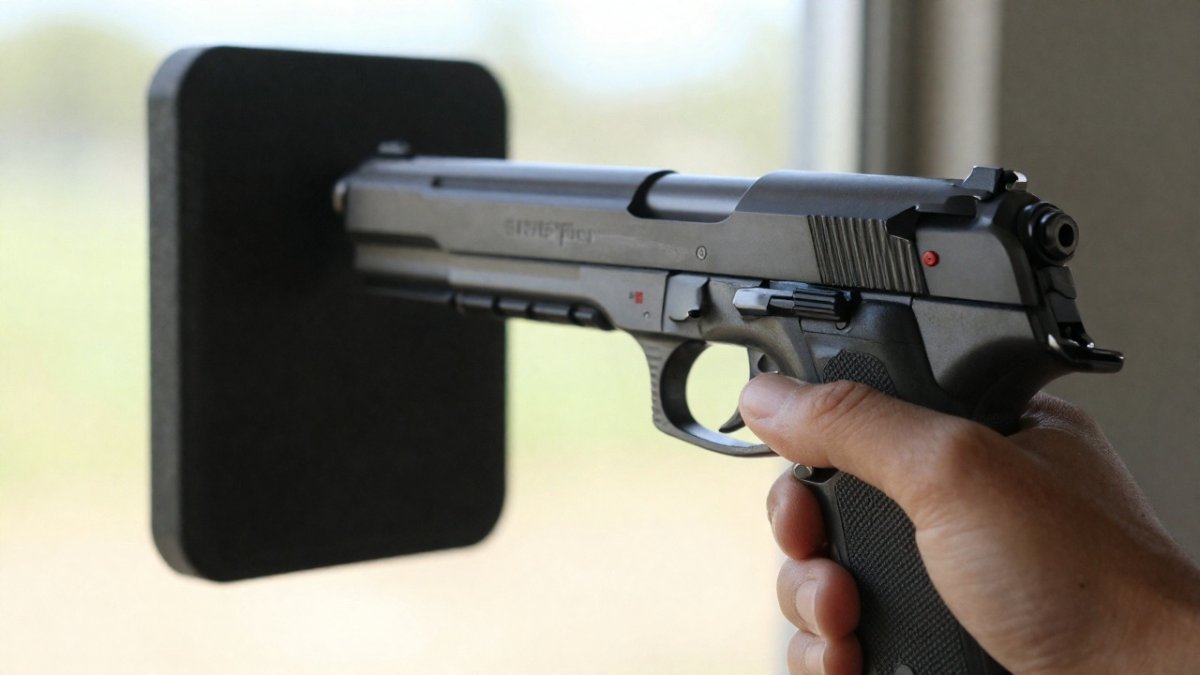
Check the Markings, Not Just the Lever
Markings beat memory every time. Many pistols stamp SAFE and FIRE right on the frame. Others use a red dot to show the fire position.
The trap is assuming every gun uses the same layout. A lever that sits "up" on one pistol may mean safe, while on another model the same position means fire. Read the stamping, then confirm in the manual.
Here is the article's general sequence for checking a firearm's safety.
| Step | What to do |
|---|---|
| 1 | Keep the muzzle pointed in a safe direction |
| 2 | Keep your finger off the trigger and outside the guard |
| 3 | Locate the safety using the manual's diagram |
| 4 | Look for engraved words like SAFE and FIRE, or a red dot |
| 5 | Move the control and watch which marking it lines up with |
| 6 | Confirm the position against the manual, not memory |
Safety on a Gun Up or Down: What the Lever Position Tells You
The short answer to whether the safety on a gun is up or down is that there is no universal convention. The direction depends on the model, and the only reliable source is the manufacturer's manual for that exact firearm.
Why the direction varies comes down to mechanism design. A frame-mounted thumb safety on many hammer-fired pistols, such as the classic 1911 pattern, is typically swept up to engage and down to disengage.
A common pattern is that the lever lines up with a stamped SAFE or a similar word when engaged, and with FIRE or a red dot when disengaged.
Never test a safety by pulling the trigger to 'see if it works.' That practice violates the rule to keep your finger off the trigger until ready to fire.
When the position or function is unclear, stop handling. Keep the muzzle pointed in a safe direction, keep your finger outside the trigger guard, do not test or rely on the safety, and consult the manufacturer's manual or a certified instructor before proceeding.
Safety on a Gun Red Means Fire, Not Safe
On most firearms, safety on a gun red means the fire position, not safe. A red indicator is a warning that the gun is ready to fire if the trigger is pulled.
That said, markings vary. Some guns use red differently, and some have no color indicator at all. Treat red as "fire" until the manual tells you otherwise.
Here is the distinction that matters most: a safety indicator is not proof a firearm is unloaded. The safety blocks the firing mechanism, not the chamber. A round can still be sitting in the chamber with the safety engaged.
- Always check the chamber directly
- Keep the muzzle in a safe direction during the check
- Never assume "safe" means "empty"
A Rutgers School of Public Health summary of a study on gun safety practices found that some precautions were linked to riskier storage habits. The takeaway for us is simple: never let one safety step replace the others.
Verify the Safety Without Pointing at Anyone
You can check a safety without sweeping anyone by keeping the muzzle pointed at a safe backstop, a berm, or the ground in a safe direction and reading the markings from behind the gun.
Follow these steps:
- Clear the firearm first, following the four rules, and keep your finger off the trigger and outside the guard.
- Point the muzzle at a safe backstop.
- Locate the safety using the manual's diagram.
- Look at the markings from behind the gun and move the control slowly, watching which indicator it lines up with.
- Confirm the position against the manual, not memory.
If you are in a class or a shop, ask the person handing you the firearm to show you the safety before you take it. There is no shame in asking, and a common mistake is pretending to know an unfamiliar model to avoid looking inexperienced.
Watch out: a safety indicator is not proof a firearm is unloaded. The safety blocks the firing mechanism, not the chamber, so a round can still be present with the safety engaged.
When the safety position or function is unclear, take the conservative path: stop handling, keep the firearm pointed safely, do not test or rely on the safety, and seek qualified instruction. Worn, obscured, or absent markings and controls that feel vague are reasons to pause, not to experiment.
The Four Rules of Gun Safety Apply No Matter the Safety Position
The four rules of gun safety never change, whatever the safety is doing. They are the foundation every other habit rests on.
- Treat every gun as loaded.
- Keep the muzzle pointed in a safe direction.
- Keep your finger off the trigger until ready to fire.
- Know your target and what is beyond it.
Widely used firearm safety guidance emphasizes muzzle direction, trigger-finger discipline, and keeping the firearm unloaded until ready to use. None of that depends on a lever position.
Mechanical safeties can fail, and they can be misunderstood. The four rules cannot. That is why these rules should be drilled in every session, from the first-time student to the experienced shooter.
Book a Hands-On Safety Session at Alex Tactical
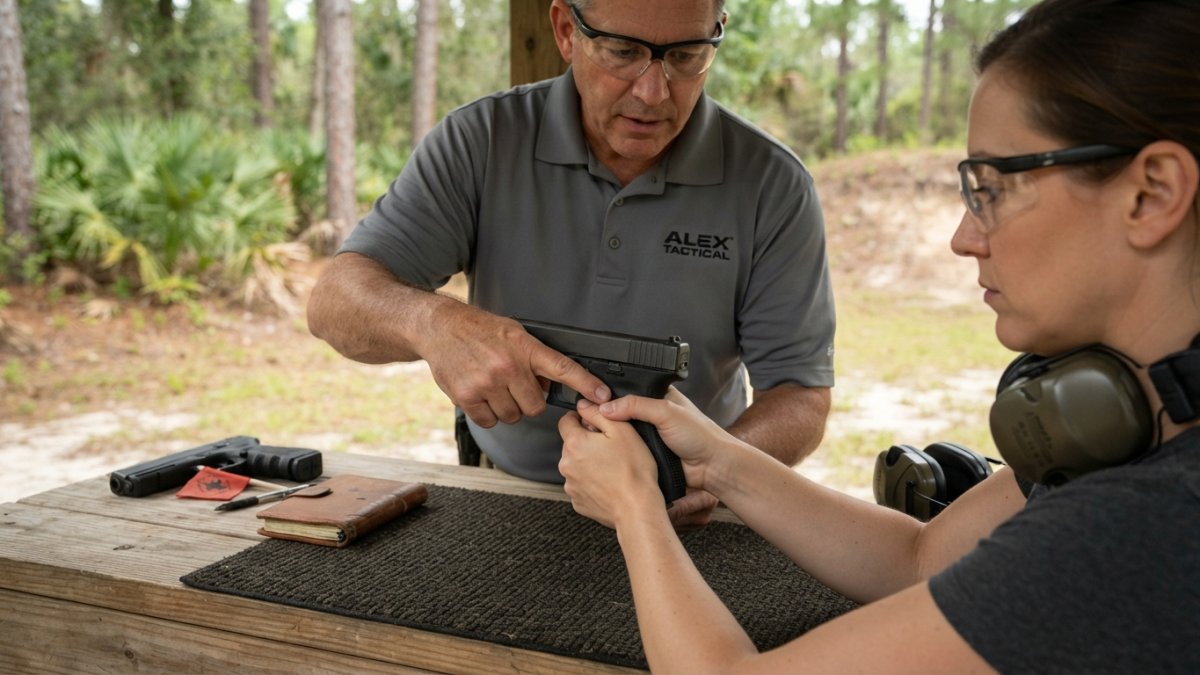
Reading about a safety lever only goes so far. The real confidence comes from handling your own firearm with an instructor beside you.
If you are nervous about guns, you are not alone. Alex Tactical offers a private outdoor range in Lady Lake, small classes capped at six students, one-on-one NRA-certified instruction, no range, lane, or firearm rental fees, and virtual gun range simulator training to practice handling before live fire.
Alex Maldonado is an NRA Certified Instructor and Certified Advanced Glock Armorer. Scheduling is available seven days a week.
Figuring out which way the safety moves is a five-minute lesson with the right instructor and a frustrating guessing game without one. Bring your firearm, or learn on ours, and leave knowing your own safety inside and out. Get started with Alex Tactical and book a hands-on safety session built around your model and your comfort level.
Frequently Asked Questions
Is a gun's safety up or down when it's on?
There is no universal up-or-down rule. On many semi-automatic pistols, pressing the lever down puts the gun in the fire position, but plenty of models work the opposite way, and some use a push-button or grip safety instead of a lever. The only reliable answer is your firearm's manufacturer manual and the markings on the frame. Check those before you assume a position, and treat any uncertainty as a reason to keep your finger off the trigger and the muzzle pointed in a safe direction.
Does a red mark on the safety mean the gun is on safe?
Usually the opposite. On most firearms, a visible red indicator near the safety means the gun is in the fire position, not the safe position. The red is there to warn you that the trigger is live. Some models use red differently, so confirm with your manual. Never rely on color alone, and remember that a safety indicator is not proof the chamber is empty. Check the chamber directly with the muzzle pointed in a safe direction.
How can I tell if the safety is on without pointing the gun at anyone?
Keep the muzzle pointed at a safe backstop or the ground in a safe direction, keep your finger off the trigger, and look at the lever and its markings from the side. You can also feel the lever position with your thumb while the gun stays pointed away. If the position or markings are unclear, do not guess. Set the gun down, unload it if you can do so safely, and check the manufacturer manual or ask a certified instructor before handling it further.
Do the four rules of gun safety still apply if the safety is engaged?
Yes. Treat every gun as loaded, keep the muzzle pointed in a safe direction, keep your finger off the trigger until you are ready to shoot, and be sure of your target and what is behind it. A mechanical safety is a backup, not a substitute for safe handling. A safety can fail or be bumped off, so the four rules of gun safety are what actually prevent accidental discharge. Alex Tactical builds every class around these fundamentals.
